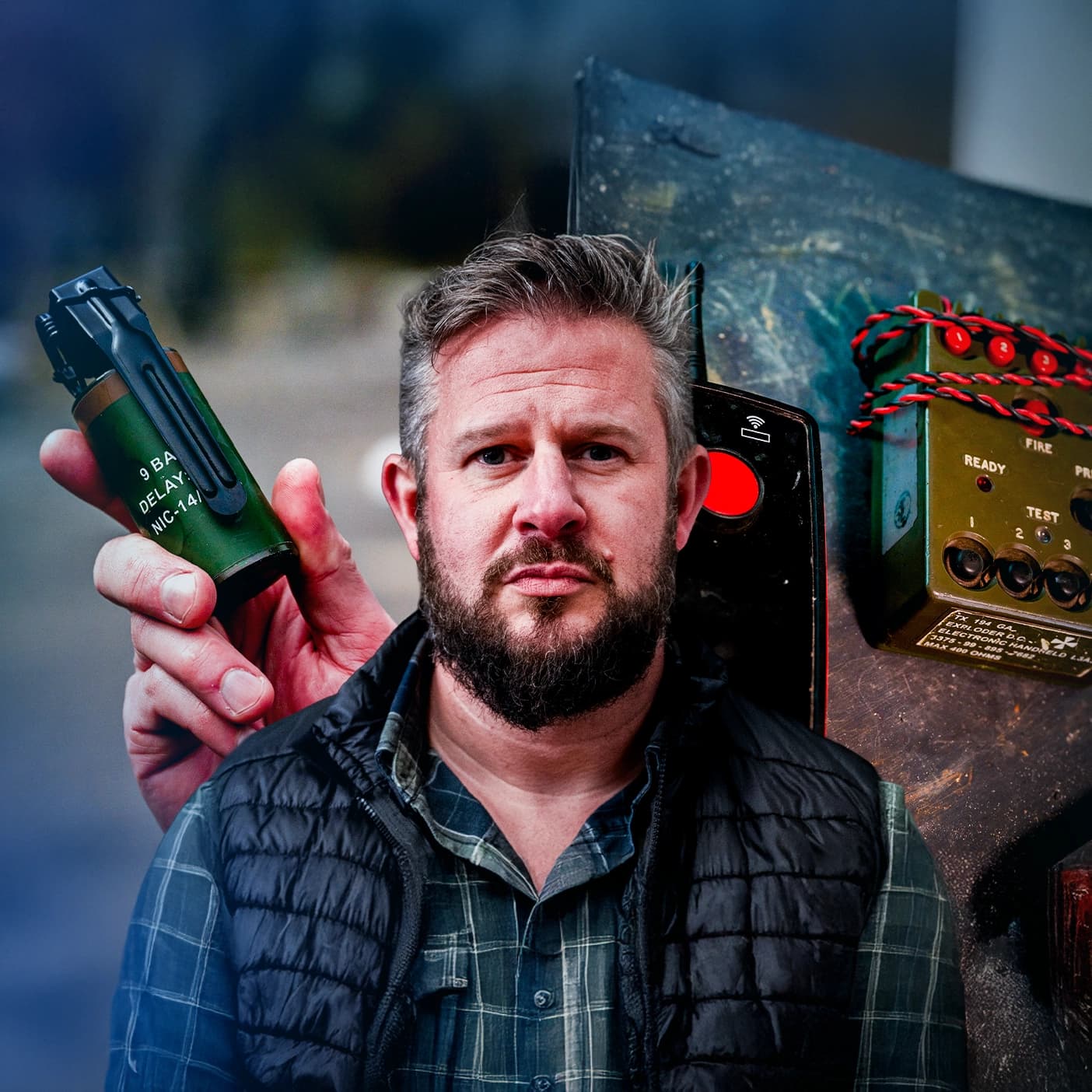
“It’s probably the loneliest walk you’ll do.”
This is what Warrant Officer Class 1 Kim Hughes, GC (Ret), said about the “long walk.” That’s the term used in bomb disposal for the walkout to defuse an explosive. All team members wait far away at a safe distance, and the explosive technician must go it alone, relying on training, experience, and a heavy armored bomb suit.
But armor can only do so much.
It only takes a few grams of explosive material to be lethal. Kim built a distinguished career in explosive ordnance disposal.
Joining the Military – an “Absolute Escape”
Kim Hughes was born into a military family. Both his father and stepfather served, so there was a certain pull that was hard to deny. He describes himself as a “hardworking student,” but also said that he didn’t feel like he was “going places” academically. After attending Thomas Telford School, what came next was uncertain. For someone in that situation, with a strong family military background, the answer is often staring them in the face. Given the difficult relationship Kim had with his stepfather, he sought to join the British Army as an “absolute escape.”
After an initial enlistment in the Royal Logistic Corps as a driver, he briefly left the service. He quickly concluded that civilian life was not for him and then rejoined the British Army in October 1997 at the age of 18. He entered the Royal Logistic Corps as an Ammunition Technician.
To perform the role, Kim had to gain a strong understanding of explosives before ever approaching one in the field. Extensive technical and procedural training formed the foundation of the set of skills that would ultimately make him a valuable explosives disposal specialist. He then progressed into Explosive Ordnance Disposal, which would take him around the world and turn him into a highly-regarded soldier of the British Army.
How Bomb Disposal Works
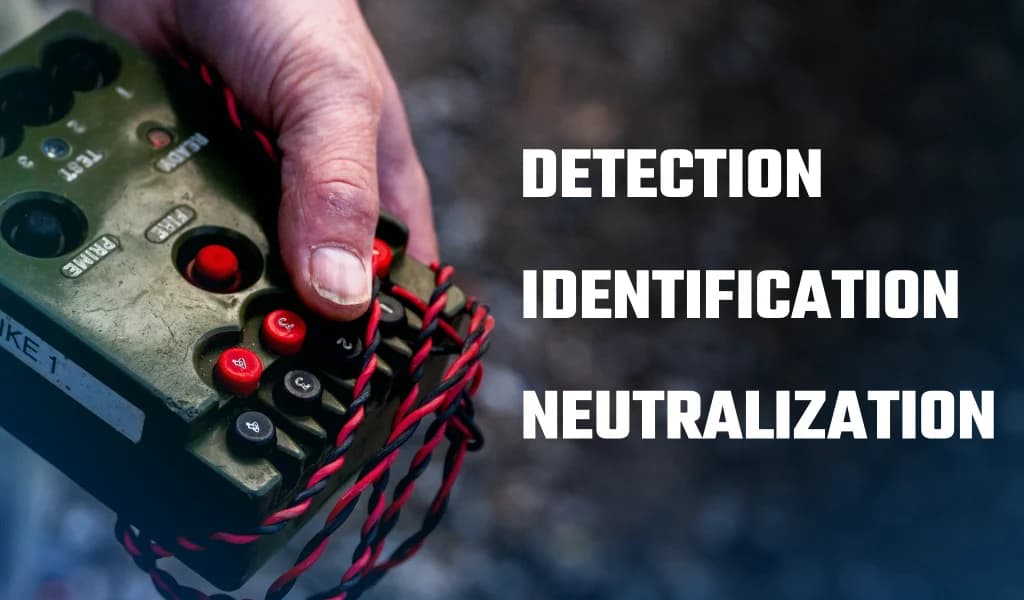
Bomb disposal typically follows three stages:
- Detection is finding out that an explosive is present. This can be as simple as noticing a suspicious object by the roadside, or could involve sophisticated detection equipment.
- Once an item is found, the identification phase is about figuring out what kind of threat the team is up against. The disposal technician seeks to understand how the device is designed, including how it can be triggered, how it is powered, and how severe the threat really is.
- Finally, neutralization focuses on rendering the threat harmless. This could involve a remote-operated robot, cutting trigger mechanisms, knocking out the power, or even transporting the object to a place where it can safely be detonated.
Dramatic reconstructions and movies aside, ordnance removal is not about developing mysterious instincts and then relying on those. Instead, it’s about eliminating guesswork as much as possible. “You fall back on your drills,” Kim writes. “You don’t rise to the occasion – you default to your level of training.” That focus on training ensures that, under pressure, the operator can rely on the skills that they have practiced many times.
“Boring” and consistent methodology is key. However, Kim admits a certain enjoyment in his work. He explains that “there’s nothing in the world that gives you the same buzz.”
Early Deployments
Northern Ireland – 1999
One of Kim’s first deployments was to Northern Ireland during the later stages of Operation Banner. The Troubles had diminished, but still bombs were appearing. Dissident Republican groups continued to place IEDs in cities and surrounding areas, threatening the lives of many citizens. Kim worked first simply as a driver for bomb disposal teams, manning the Tactica, a specialized armored bomb disposal vehicle. While serving in Ireland, Kim learned many of the preliminary skills that would serve him later in his career when deployed closer to active battlefields.
Bosnia – 2002 and 2003
The Bosnian war left the country torn and tattered, and littered with landmines and unexploded ordnance. Remnants of a past conflict meant that there were munitions left behind in fields, roads, and other areas. Unlike the work in Belfast, this wasn’t about immediate response, but about methodical clearance. Landmines in particular can stay lethal for years and years beyond a conflict, endangering civilian populations for generations to come.
Kim was a Lance Corporal during his deployment to Bosnia, working with the 11th Explosive Ordnance Disposal Regiment, Royal Logistic Corps. There was a lot to learn technically from a wide variety of devices, including older munitions that relied on varied construction methods. It served as a useful training ground for Kim to continue to develop his skills and knowledge. These would ultimately be vital when he rotated into hot war zones in the coming years as the West waged the War on Terror and fought in the Middle East.

Iraq – 2006
Iraq presented yet another set of challenges. This time, improvised explosive devices (IEDs) were the defining threat of the conflict. As Kim explains, when it comes to IEDs, “there is no manual.” This means that it is essential to be focused and attentive, as standard armaments were not the main challenge.
Insurgent groups made explosives from all kinds of materials in this conflict. Triggers varied as well, incorporating pressure plates, command wires, and radio signals to set off a device. For a bomb disposal technician like Kim, each explosive is a different kind of challenge and requires a different approach to defusal. Kim describes the unpredictability of these devices and the need to expect variation. A soldier can’t make the mistake of assuming that one IED will function like another, or it could lead to a fatal mistake.
The basic rhythm of disposal would start whenever a forward team discovers a suspicious device. EOD teams would then be called up. Units would halt their movement, then establish a perimeter. After that, all they could do was wait for the operator to arrive and solve the problem. This work gave Kim plenty of experience in counter-terrorism explosives removal, which would culminate in the high point of his career on a deployment to Afghanistan.
Afghanistan – 2009 – Earning the George Cross
Following Iraq, Kim also served in Afghanistan. There, the IED threat was similar, but the terrain and tactics were different. Bombs were hidden along rural tracks, in compounds, and under dirt roads. Detection was hard, and as always, tactics were a moving target. Insurgents evolve as conflicts wear on, adjusting their practices to avoid detection and seek maximum lethality.
In Afghanistan, Kim continued to pull explosives out of the ground. He reports that, even with his broad base of knowledge at that point, it was still essential to tackle each challenge “in its own right.” That meant not assuming any device was exactly what it looked like and approaching every situation with the same level of care.
George Cross Recipient
The George Cross is one of the United Kingdom’s highest gallantry awards and is given for acts of great bravery not in the presence of the enemy. But when you’re staring down a bomb that could go off at any second, the danger is immediate and constant. Kim was awarded the George Cross for his work on one fateful day in Helmand Province, Afghanistan, on August 16, 2009. At the time, he was a Staff Sergeant still with the 11th Explosive Ordnance Disposal Regiment.
The incident began when a troop patrol hit an IED, and then another. Two soldiers were killed, and four were wounded. There was a problem, of course, with getting out the wounded. The ground was clearly rife with explosives. Teams couldn’t take a single safe step without the go-ahead from the EOD technicians. Kim’s team got right to work. He manually defused seven IEDs on a circuit to clear the way, all without wearing a protective bomb suit. One device was even located within a meter of a wounded soldier. But there was no time to waste, and Hughes put himself in harm’s way time and time again.
His George Cross citation referred to this as “the single most outstanding act of explosive ordnance disposal ever recorded in Afghanistan.” What stands out in both the citation and Kim’s own account is the sheer stamina it takes to do things correctly in a series. Anyone who has experienced mental fatigue at work can imagine trying to operate when a mistake could mean certain death.
It takes full concentration, and there’s really no room for error. There also aren’t any shortcuts. The process can’t be rushed. To make it through, Kim kept his attention on the immediate specifics that were apparent in each situation. He writes, “You concentrate on what’s in front of you, nothing else.” During the whole tour of duty, he actually made safe 119 IEDs. He says that bomb disposal is “about doing the same thing, the right way, every time.”
That focus defines his approach to the job.
Life After the Army
Authorship
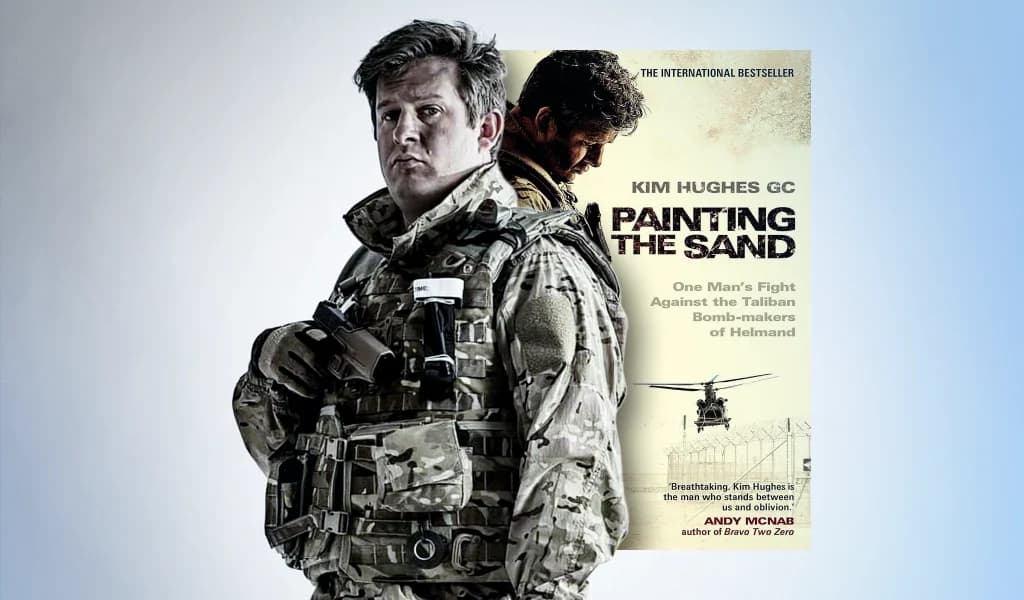
After leaving the army in 2020, Kim returned to writing to preserve his experiences. Painting the Sand provides a detailed account of his time in Afghanistan. Readers can learn all about EOD work from the perspective of someone who had to step up to the challenge time and time again. It’s not a super dramatic account (for that, you can read one of his fictional thrillers: Operation Certain Death), but rather explains the process, routine, and realities of the job.
In explaining why he wrote the book, Kim talked about how he wanted to show a more accurate picture of what bomb disposal work is really like. Movies are big on spectacle, but his account emphasizes discipline and the humble idea that, “It’s about doing your job properly.”
Consultancy
After leaving the Army, Kim moved into counter-terrorism consultancy work, where he can instruct others about explosive threat awareness and risk management. He has advised on counter-IED measures, training frameworks, and security planning for clients that are in the public and private sectors. Despite the desire to show the professional, workmanlike side of explosives removal, he has also served as a film and television technical advisor. His role is to help ensure that depictions of bomb disposal and military procedures are accurate, and that the media doesn’t get too carried away with drama.
Kim’s career has spanned multiple phases of modern conflict, from places that have moved on from war to highly dangerous, active combat zones. All environments required the same underlying approach: methodical, process-driven work carried out under high-pressure conditions with no room for failure.
The devices have changed, the environments have changed, but Kim’s core method never did. That’s the humble truth at the heart of a career built on doing things right, no matter how frightening the situation was.
Watch Kim on the Team Ignition Show
In this episode of the Team Ignition Show, after sharing what it truly feels like to face a live IED up close, Kim takes Selema through the training methods he uses to prepare for the most high-stakes moments imaginable – before demonstrating the raw, terrifying power of a real car bomb.