Selema Masekela, host of The Team Ignition Show, got his start hosting the X Games in 2003. What began as a high-energy experiment 30 years ago is now a global sports institution. Legends are made at the X Games, tricks are invented, and the boundaries of what is possible on a skateboard, bike, or snowboard are redefined and pushed outward with each competition.
The Beginnings of Something New (1995-1999)
ESPN launched the “Extreme Games” in 1995. It wasn’t exactly meant to mimic the Olympics. It was an experiment in riding a cultural wave of interest in newer sports. Things like skateboarding had gone from being highly niche activities to something kids were doing around the world.
Skateboarding, BMX, and snowboarding were at this point still not quite mainstream and were a very long way from being considered legitimate competitive sports. For the early X Games events, that was just fine.
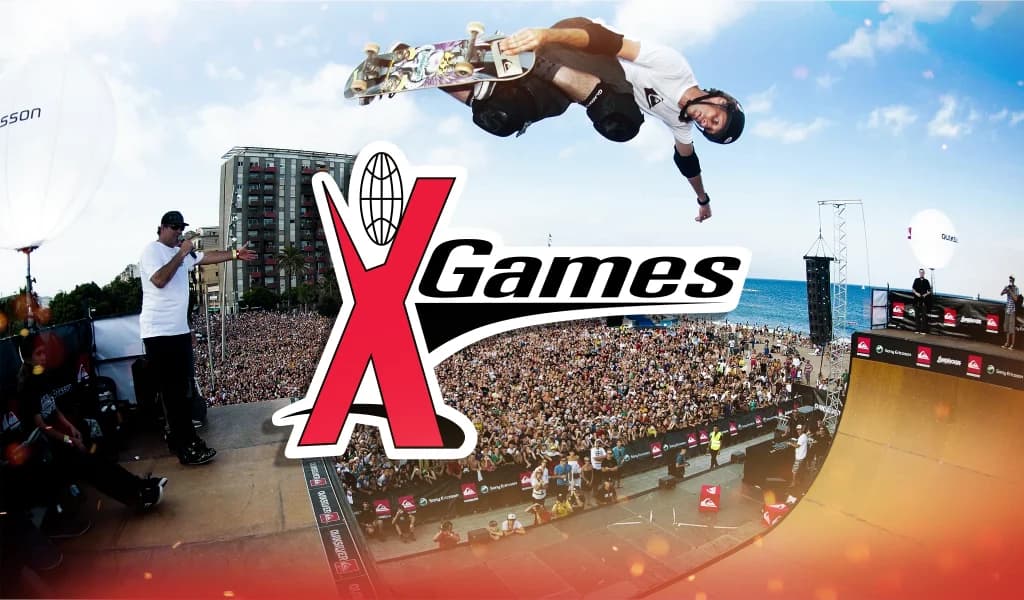
The first X Games was held in Newport and Providence, Rhode Island. It felt less like a polished sporting event and more like a live festival. The organizers leaned into that identity. The music was loud. The formats were pretty loose. Style and swagger were every bit as important as the actual results.
The gamble worked. Ratings were strong, sponsors rallied to the spectacle, and the event immediately signaled something interesting: “X sports” didn’t need to be reshaped to fit the old mold. Instead, they could stay true to their own culture and pull in a big audience that was ready for something new.
A landmark moment eventually came in 1999 when skateboarder Tony Hawk landed a 900 (the first ever) in competition. To pull a “9,” a rider goes up a halfpipe wall, does two full rotations in the air, and then lands facing the other way (i.e., 360° + 360° + 180°). Viral video on the Internet wasn’t even yet a gleam in YouTube’s eye at this point, but this clip ran everywhere on TV, becoming a cultural event right away. X Games had become a place where relevant sports history could take place.
This also gave the X Games one of its central missions: jaw-dropping progression of tricks.
Expansion and New Identity (2000–2005)
As events grew, they drew in more and more athletes from abroad. Winter X Games, held in Aspen, offered unbelievable sights and became must-watch TV. Snowboarding halfpipe and slopestyle events sent athletes into the stratosphere, throwing tricks that were bigger than any casual rider ever thought possible. Even freeskiing started to take off.
Judging criteria also became clearer. Difficulty mattered, but so did flow, amplitude, and commitment. It wasn’t enough to just barely land a trick. To win golds, it was important to show mastery.
- In BMX, Dave Mirra dominated with flairs and tailwhip-to-barspins, which became staples of early competitions. Riders like Kevin Robinson repeatedly attempted the double backflip, showing what it would take in the coming years to reach the top of the sport.
- On snow, freeskiing was taking off thanks to France’s Candide Thovex, who brought fluidity to slopestyle with gorgeous-looking switch 900s and rodeo 720s.
- A young Shaun White, who would later earn golds are three different Winter Olympic Games, gave audiences a preview of what he was capable of. He landed massive frontside 1080s and pulled monstrous method grabs that reminded fans that the “rule of cool” would always be relevant.
Trick Explosion (2006–2012)
In previous years, the X Games made its mark and earned a place on TV and in fans’ hearts. In the late 2000s, athletes continued to show that – yes – they could still go bigger. Much bigger.
In 2006, Travis Pastrana landed the first double backflip in Moto X competition. He had accomplished the unthinkable. In six short years, the X Games had gone from the first motorbike backflip to a fully completed double backflip. Things were progressing incredibly fast, and the boundaries of what was possible kept getting pushed further and further away. It was an era where athletes were truly trying to find the human limit. Tricks that people wouldn’t dare attempt at one point became standard staples that were needed merely to hang with the pack in X Games competition.
- In the snow, halfpipes got even bigger, growing from 15 feet high to 22-foot superpipes. In 2012, Shaun White scored the first perfect 100 ever awarded (in SuperPipe), generating yet another headline.
- In 2007, Norway’s Torstein Horgmo landed the first cab double cork 1080, which opened the door to switch double corks.
- Danny Davis kept his halfpipe performances expressive, showing that amplitude, grabs, and flow could still win against pure spin math.
- In freeskiing, Bobby Brown stomped a double cork 1440, and put to rest the idea that skiing would forever trail snowboarding on spin count.
Tragically, the cost of progression finally hit home in 2012 when freestyle skier Sarah Burke died following a training accident. It made it obvious that X Games sports were long overdue for bobbyserious conversations about improving safety requirements and course designs, especially for women’s events.

New Olympic Events and Global Stars (2013–2018)
Years of advocacy had finally turned X Games sports into Olympic events. While snowboarding was added at Nagano in 1998, it took another 16 years for freestyle skiing to arrive at the 2014 Games. The interplay between events saw the X Games become something of a lab for tricks. Fans would watch a new trick at the X Games, and then it would appear in Olympic competition years later.
Many of the most dominant athletes would compete in both events, winning X Games and Olympic medals. Chloe Kim arrived and immediately was acknowledged as a prodigy, winning SuperPipe gold at 14. The women’s field deepened quickly, and the ceaseless march of progression continued on. Kim would win multiple Olympic gold medals in halfpipe and is poised to compete once again at Milano-Cortina in 2026, despite a shoulder injury.
Unfortunately, the risks of X Games sports claimed another life. In 2013, snowmobiler Caleb Moore died after injuries sustained during a Winter X Games competition. Fans see X Games athletes in all their larger-than-life moments, but these athletes are still human – they are still real people taking on very real danger. Once again, a recalibration on safety was needed. And as the X Games community rallied to grieve and celebrate the legacy of a brave athlete, organizers resolved to work to put in place new protocols that would make extreme sports as safe as possible.
Into the Modern Era (2019–2026)
The shocking moments have never really disappeared, but X Games is all grown up now. Competitors like Chloe Kim and Canadian snowboarder Mark McMorris win through precision and composure as much as just sheer difficulty. The pandemic-era Games of 2020 and 2021 made festivals impossible, but put the focus squarely on competition. San Francisco’s Eileen Gu put on performances for the ages, winning multiple X Games gold medals across three disciplines – halfpipe, slopestyle, and big air.
The X Games themselves also changed. By 2022, creative formats like Knuckle Huck offered audiences something different than spin-counting.
From 2023 onward, the X Games were redefined, adopting a more professional, league-minded format under new ownership. For Winter X, Aspen is still the anchor. Young athletes show up already whipping double corks, switch rotations, and nailing tricks under pressure. Things feel steadier now, but the demands are still at the very limits of what a person can do. Progression is there, but greatness is measured by longevity, adaptability, and the ability to keep raising the ceiling even when the sport itself seems fully grown.
Aspen 2026 Winter X Games Results
- In women’s snowboard SuperPipe, the podium was young and international. Japan’s next generation took full control and proved that the future is already here.
- In men’s SuperPipe, Scotty James stamped his legacy with his fifth straight SuperPipe victory.
- Men’s Ski Big Air went to Mac Forehand, who will ride for Team USA in the 2026 Games in Italy.
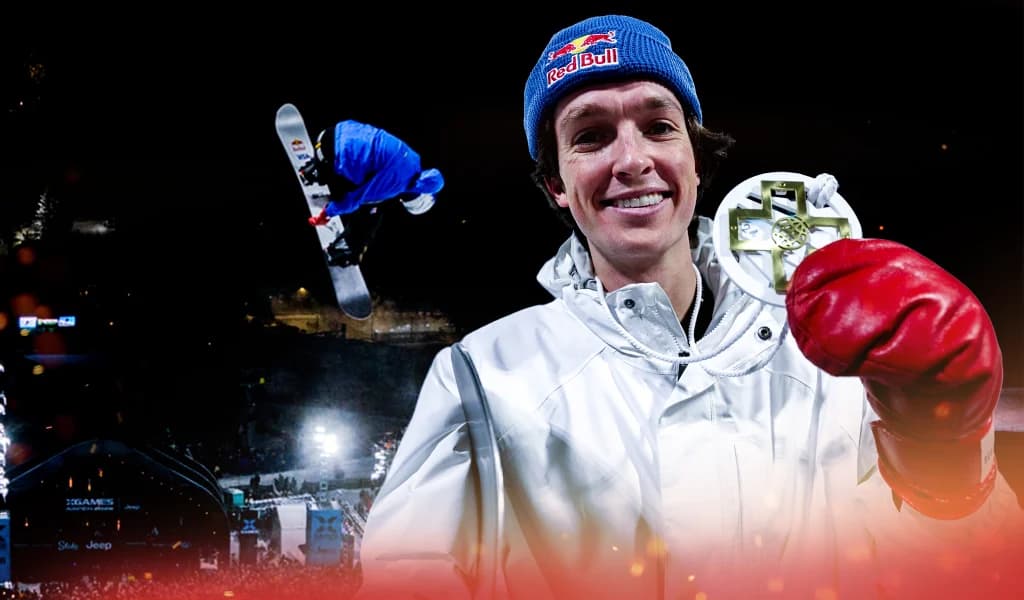
- And with another medal haul, legendary snowboarder Mark McMorris became the most decorated winter athlete in X Games history. His trophy case holds 25 total X Games medals, including 14 golds. He, too, will look to add to his treasure hoard in Italy, riding for Team Canada in slopestyle (he has three consecutive bronzes in that event) and big air.
X Games Most Decorated Athletes
- Bob Burnquist – one of the godfathers of X Games skateboarding. He has more than 30 medals across vert, park, and big air, defining longevity.
- Tony Hawk – a foundational figure whose medal count (including 6 golds) and era-defining tricks helped turn the X Games into a household name.
- Dave Mirra – dominated the BMX park in the late 1990s and early 2000s, winning 24 medals through unmatched consistency and control.
- Mark McMorris – the GOAT of winter X (25 medals), with a legacy built on sustained excellence in slopestyle and big air.
- Shaun White – a halfpipe legend whose 13 gold medals and perfect-score performances defined a generation.
- Travis Pastrana – a Moto X icon with 17 medals.
- Nyjah Huston – the dominant force of modern street skateboarding, with 15 medals to his name.
Why X Games Still Matters in the Olympic Era
Olympic competitions measure excellence and technical precision. X Games does that as well, but as ever, it measures and redefines possibility.
Tricks get their names at X Games. Careers take off. Entire sports pivot based on one athlete’s performance. Risk and creativity push and pull back and forth over the years. Audiences will continue to sit on the edges of their seats as they watch for a moment where one human being changes everyone’s idea of what can and what cannot be done.