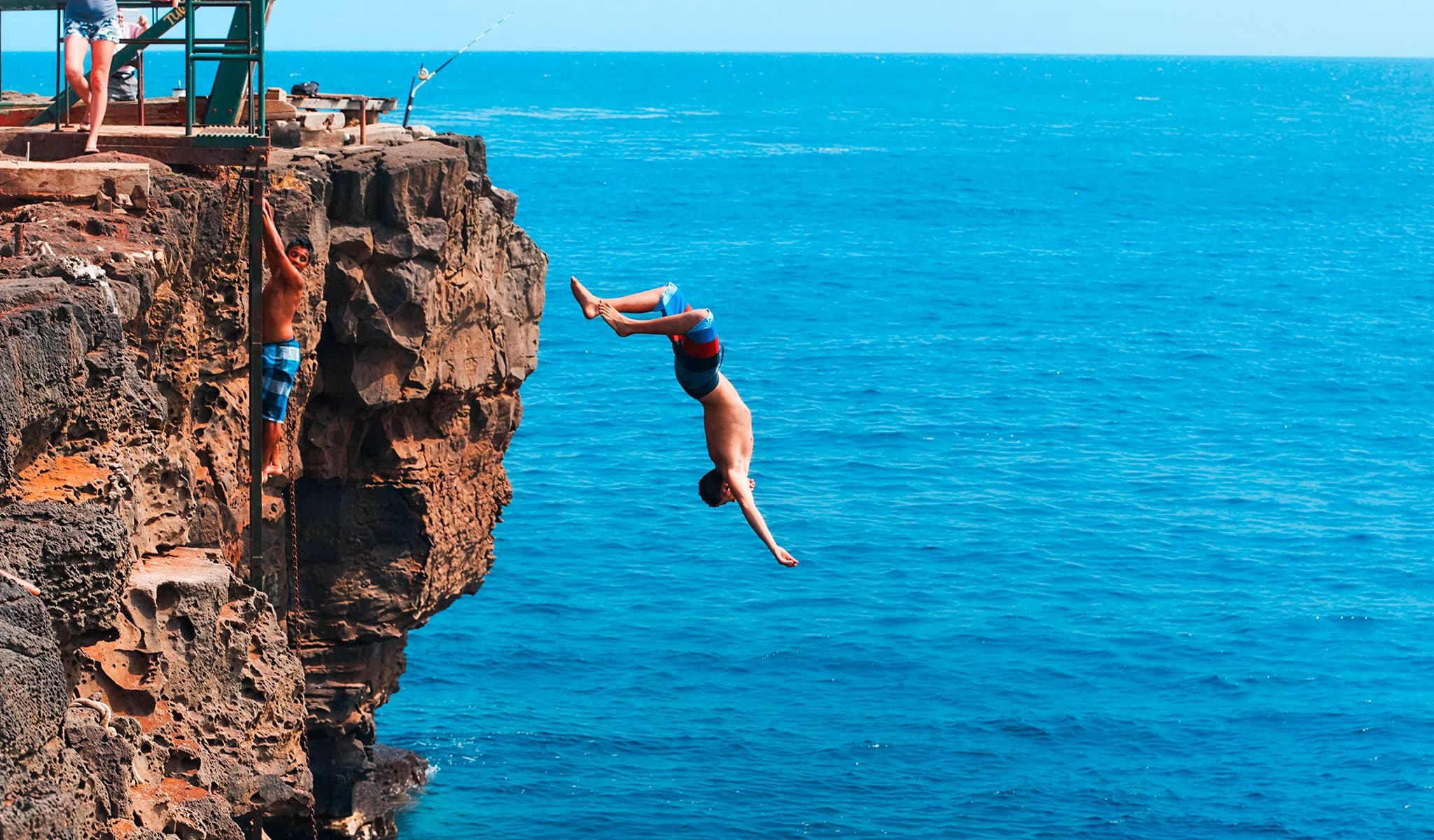
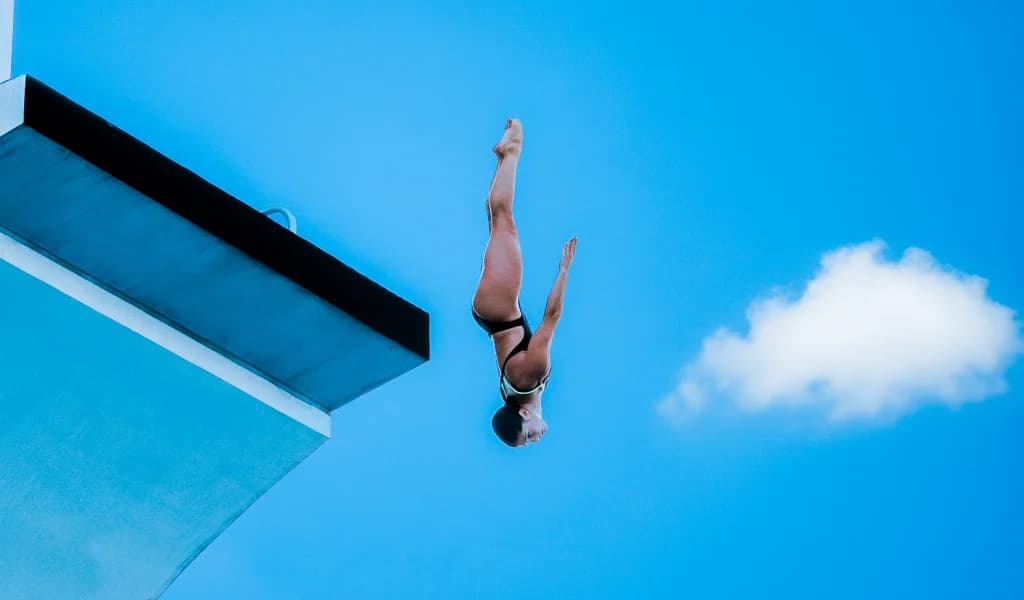
Selema Masekela plunged straight into the world of cliff diving when he sat down with Morgane Herculano, an Ivy League graduate and 23-time national champion who traded a research career at Harvard for one of the most dangerous sports on earth. In this interview, Morgane breaks down what it feels like to hit the water at 53mph and absorb 10 G’s of force, the same as a Formula One driver, how she resets after watching friends suffer terrifying accidents, and the way she fights back against the cruelty of online trolls.
Anatomy of a High Dive
They call it “high diving” for a reason: high divers jump from platforms that are 20-27 meters (65-88 feet) tall. Imagine jumping from somewhere between the seventh and ninth floors of a building. It’s a long way down. Divers then fall for about three seconds before they hit the surface of the water below. In that time, they twist and flip, and then have to orient their body into a near-perfect vertical line before the grand finale. The impact as they hit the water can be equivalent to a car crash, so they have to land just right. If all goes well, they’ll slice into the water with a tiny splash. Then they’ll surface, swim to the edge, get out of the water, and climb the dive tower to do it all over again.
High diving is one of the most technically demanding and physically punishing sports that an athlete can do. It combines gymnastics, physics, and even psychology. It takes training, calculation, and raw nerve to become a successful diver. But where did it all start?
The Heights and the History
High diving is something that humans have done for ages, but the organized competitive sport is younger than most would think. While cliff diving has a history stretching back centuries (for example, the famous La Quebrada divers of Acapulco), competitive high diving only joined the international aquatics calendar officially in 2013. That was the first year it was offered at the World Aquatics Championships in Barcelona.
Under World Aquatics rules, men compete from a 27-metre platform and women from 20. Divers hit the water at speeds of over 50 miles per hour, and the impact at entry can reach close to ten times the force of gravity, forces extreme enough that the height difference matters significantly for injury prevention.

Red Bull Cliff Diving World Series (CDWS)
Red Bull’s event, which has run annually since 2009, now draws crowds of tens of thousands. For years, it has been the main way that the sport has grown its global audience. Competitors dive from platforms perched on cliffs, castle walls, bridges, and custom structures that are positioned above oceans, rivers, and lakes. This adds a fun factor that pure pool competition doesn’t have.
The Physics of the Fall
The physics of a high dive begin when the diver leaves the platform. They enter freefall, begin getting pulled by gravity, and will work with whatever angular momentum they generated at takeoff. Unlike in the water or on the ground, they can’t create new rotation once airborne. They can only redistribute the rotation they already have.
Moment of inertia and rotation speed
Moment of inertia (an object’s resistance to changes in its rotational motion) is central to high diving. When a diver pulls their body into a tight tuck, with their knees drawn to their chest and their arms folded close, they reduce their radius of rotation. This decreases their moment of inertia and causes them to spin faster. When they extend outward into a pike or straight position, their moment of inertia increases and rotation slows. Elite divers manipulate this constantly in the air, accelerating through rotations in tuck position and then decelerating as they open out for water entry. In short, they use their body shape to control timing with total precision.
Entry
The entry itself is a technically critical moment. Divers try to hit the water at a 90-degree angle. They aim to be perfectly vertical, with their hands clasped together and palms flat. Divers call this the “rip entry” because it sounds like ripping paper. Their hands break the surface tension of the water, which creates a cavity that the rest of their body can pass through. If the entry angle is even slightly off, some of their body hits undisturbed water and has to break the surface tension on its own. This creates the dreaded splash, which costs them points in competition and can hurt quite a bit more than a proper entry.
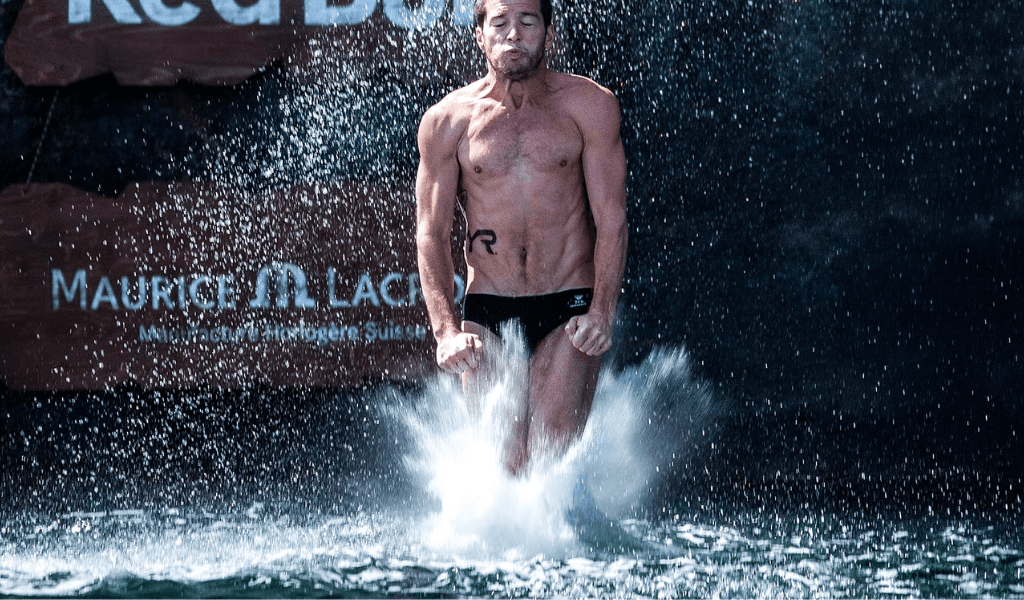
At 50 miles per hour, the deceleration from full speed to zero happens in about a second. The forces involved are significant. They’re concentrated in the diver’s hands, wrists, arms, and shoulders. For this reason, many high divers will tape their wrists to prevent injury on impact. They also spend years building the upper body strength they need to absorb entry impact without getting hurt.
Rotations, Difficulty, and Scoring
Five judges rate divers on a scale that goes from 0 to 10. The highest and lowest scores are discarded. The remaining three scores are added and then multiplied by the degree of difficulty (DD). The DD increases based on the number of somersaults, body position (tuck, pike, or free), the number of twists, and the entry direction. For example, in the Red Bull CDWS, required dives in early rounds are capped at a DD of 2.6 for women and 2.8 for men. Optional rounds are uncapped.
Dives are also classified by their takeoff direction, which could be forward, back, reverse, or inward. This classification is combined with rotational complexity. Fans might hear a dive referred to as a “front triple somersault with a half twist in pike position,” for example. Learning a new dive at competition height doesn’t happen quickly, either. Top coaches may give a diver months to build up to the final dive, using lower platforms, harness training, and incremental height increases along the way.
Mindset and Mental Training
High diving is every bit as much a mental discipline as a physical one. The basic fear of heights (or just nervousness) is one of the first problems any diver has to overcome. And they will have to keep overcoming it for years. It is always an intense feeling to stand at the edge of an eight-story dive platform and get ready to jump off it. The question is how well a diver manages it. It’s a bit like knowing when to push or fold in poker, when your whole tournament life is on the line and the prize pool is big.
Visualization is a key way that high divers prepare. Before every competition dive, they mentally go through the exact sequence of movements that will take them to the water below. The goal is to have it ingrained in their mind so that they will have a feel for the flow of the dive before a single muscle fires.

Breathing protocols, pre-dive routines, and the ability to reset mentally after a bad dive are also important. If a diver only has four rounds to reach peak performance, a single bad entry can keep them off the podium. They need to have the ability to ascend the platform and perform the next dive with full focus, regardless of what just happened. In fact, the power to bounce back is a defining characteristic of many of the best high divers.
In addition, coaches might emphasize adaptability. High divers don’t get to perform under perfectly controlled conditions at a pool. Instead, high diving happens outdoors in lots of different environments. Wind can change aerodynamics mid-flight. Cold water leads to harder impacts. Unfamiliar platform surfaces affect how a diver launches into the air. Divers need to be ready for the unexpected.
The Athlete’s Body
High divers need to train a very specific set of muscles. One of their training priorities is core stability. They must keep their bodies straight as an arrow to hit good entries. They also must have strong shoulders to manage entry impact. Knees are also important to focus on. They take the second wave of impact and can’t waver as they hit the water.
Divers have to be able to recover from a lot of impacts. A big practice session with multiple competition dives may leave them bruised and sore. Their recovery team will have to help them stay strong and out of pain if they’re going to manage their training load and arrive at a competition confident and ready to throw their best dives.
A Growing Sport
High diving is still a niche discipline compared to Olympic platform diving, but the audience has grown substantially over the past decade, largely driven by the Red Bull Cliff Diving World Series and the rise of social media stars like Morgane Herculano. Competitions now draw big live crowds in locations ranging from Norway to Japan, and individual divers have serious followings.
What the sport offers is visceral. People ascend to dizzying heights and not only jump, but perform incredible acrobatics on the way down. And somehow, they cut the water like a knife when they finally reach their landing. All that height and still no splash – what high divers do will always be impressive.