After the jump, I thought I could handle anything.
At least that’s what I told myself.
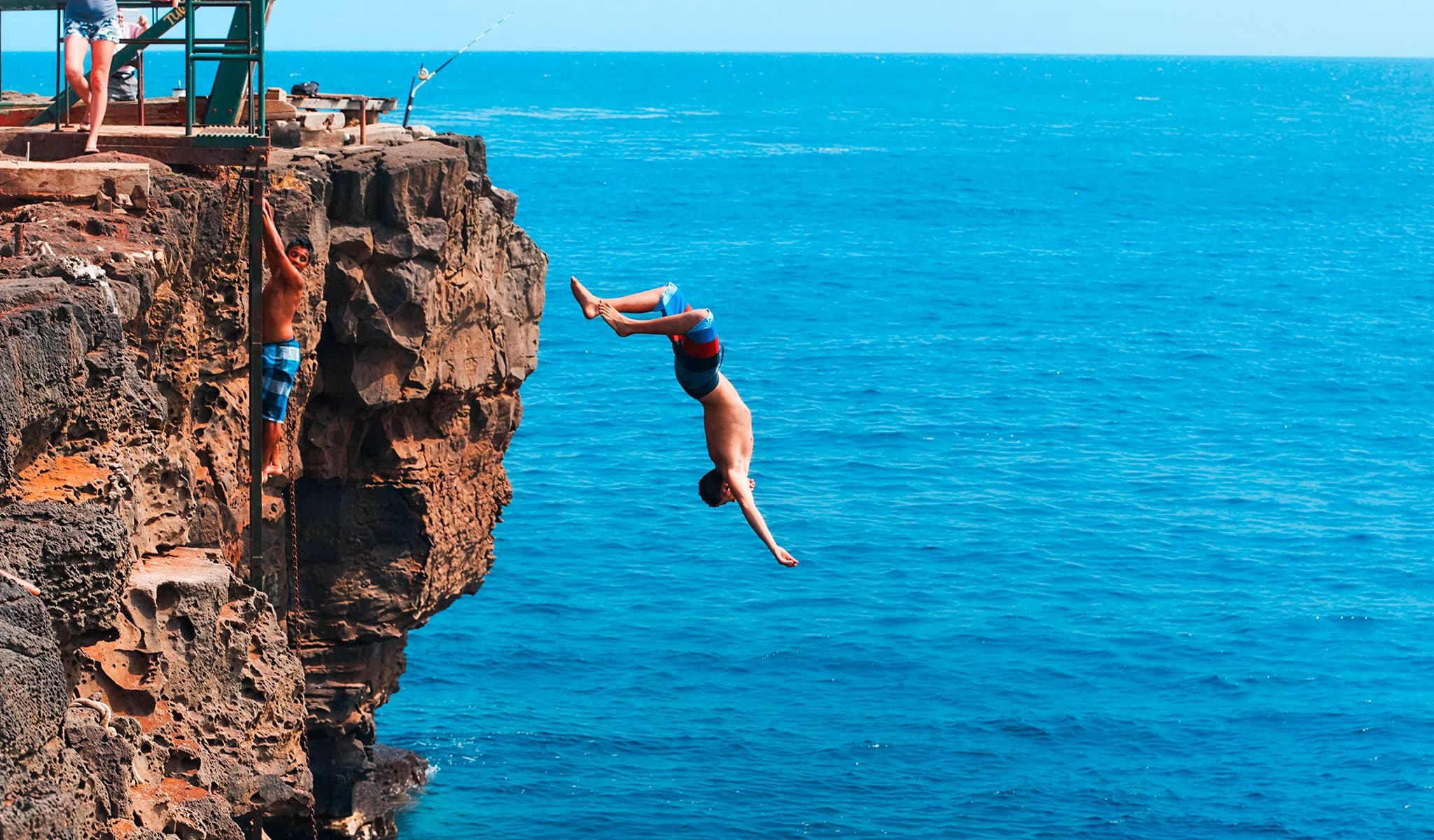
I had just jumped off a 400-foot cliff. I had stared one of the greatest fears of my life in the face, stepped straight into it, and somehow came out the other side. In my first blog, I wrote about that experience and asked the bigger question: What is fear? I had gone into the desert trying to understand an emotion that had ruled so much of my life, and what I found was that fear was not just something to avoid. Maybe it was something to honor. Maybe it was the ignition.
But even after all of that, I still found myself wondering something else:
What comes after fear?
Because after the jump, I thought maybe that was it. Maybe I had crossed some invisible threshold. Maybe I had finally broken through a wall I had been pressing against for years. I had seen what existed on the other side of fear — or at least I thought I had.
And then came the invitation.
Psycho Tower.
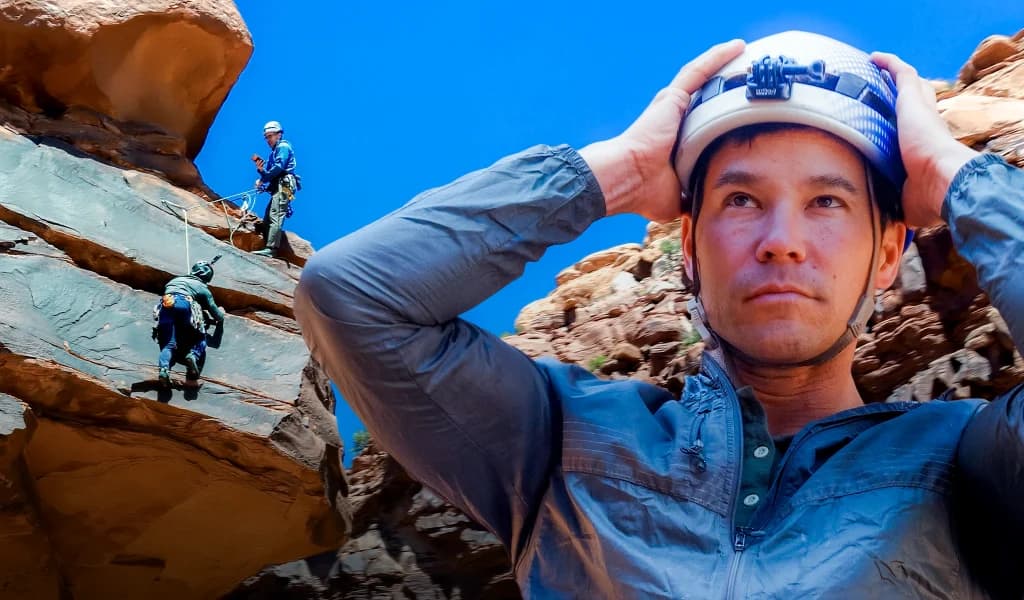
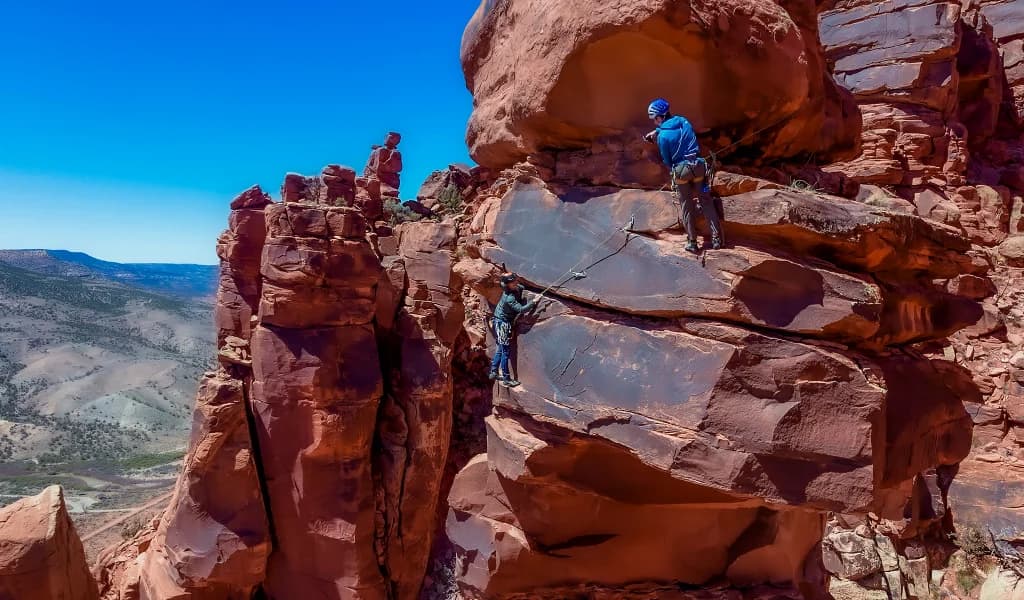
A desert tower in southwestern Colorado’s Big Gypsum Valley, known for its striking position and a classic multi-pitch trad route called Psycho-Path. It has a reputation as a beautiful, intimidating, and serious desert objective — the kind of formation that instantly commands your respect. Appropriately named, I thought, because at this point, trying to confront fear this directly almost felt psychopathic. Like only a psychopath would willingly sign up for this kind of suffering. Haha.
Just the name alone was enough to make something in my body tighten.
A Different Kind of Fear
This was not another rope swing. This was not a few seconds of intensity followed by release. This was an intimidating, coveted desert tower, the kind of thing that feels very much out there in every sense of the phrase. Remote. Exposed. Beautiful. Unforgiving.
And something in me knew immediately that this was not the same fear.
This was another fear altogether.
If the jump was about anticipation — the terror of the edge, the buildup, the countdown, the split second of total surrender — this was something slower and stranger.
Sustained fear is the type of fear you have to negotiate.
A fear you can’t escape.
A fear you can’t just get through in a few seconds.
When you’re climbing a multipitch tower, the only way off is up — and then back down. Which means you have to negotiate with fear not for a moment, but for minutes, even hours, with hundreds of feet of exposure beneath you. You don’t get one giant burst of terror and release. You get a long conversation with fear. Sometimes silent. Sometimes loud. Sometimes all-consuming.
And that changes everything.
Meeting Cedar Wright
The person I was heading out there with made it feel even more significant.
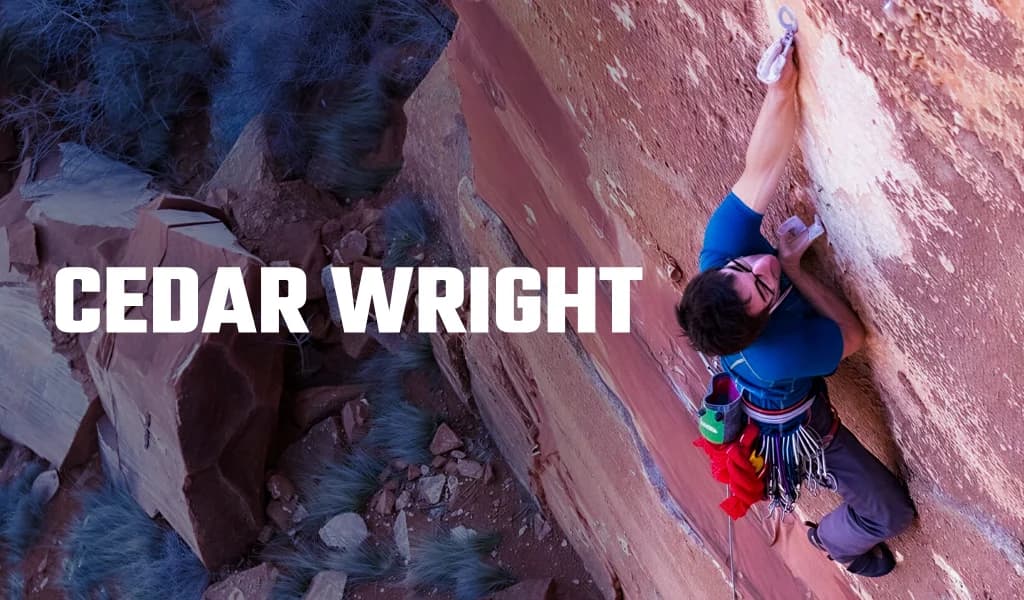
Cedar Wright is a climbing legend. He’s someone I had crossed paths with a couple of times over the last 20 years, and now we were reconnecting in a much bigger way — through these terrifying climbs that were absolutely pushing my boundaries. There was something surreal about that. To reconnect with someone like Cedar, not casually, but through an experience that demanded so much from me physically and mentally, made it all feel even more real.
I met up with Cedar near sunset in the desert.
The light was low, golden, almost mythic, the kind of desert light that makes every wall look both sacred and impossible. We walked toward the base of the formation and looked up at the route we would climb the next morning. Cedar pointed up toward the tower and said, “In 12 hours, JJ, you and I will be climbing that.”
I remember just staring at it.
No way.
Oh my god.
I had already done the jump. I had already survived the thing that had been haunting me for weeks. And yet standing there below that tower, I could feel a completely different form of fear beginning to take shape.
It’s one thing to jump off a cliff.
It’s another thing entirely to spend hours suspended on the side of one.
The Night Before
That night around the campfire, I kept thinking about how different these two fears were.
The jump had been a violent anticipation. It lived in the buildup. It consumed the days before. It hijacked my sleep, my appetite, my thoughts, my nervous system. Then it exploded in a few seconds of total intensity.
But climbing was different.
Climbing was the kind of fear that waits for you at every move.
The kind of fear that does not go away just because you have already started.
The kind of fear that says: You are still in this. You are still exposed. You still have to keep going.
That’s when I started to realize that maybe fear is not one thing.
Maybe there are different species of fear.
There is the fear of anticipation.
The fear of impact.
The fear of exposure.
The fear of duration.
The fear of being trapped in the middle of something that asks more of you than you know how to give.
And each one reveals something different.
That night, under the desert sky, OUT THERE started becoming something deeper for me.
Not a show about conquering fear.
Not a show about pretending to be fearless.
Not even a show about adrenaline for its own sake.
It was becoming something else.
A way of following fear to see what it reveals.
A way of using fear as a map.
On the Wall
The next morning, when we started climbing, the fear arrived immediately.
The rope.
The wall.
The exposure.
The realization that once you leave the ground, you are entering a new agreement with yourself.
What struck me most was that on a tower like that, fear doesn’t just crash over you once.
It stays.
It walks beside you.
It breathes with you.
It waits at every ledge, every sequence, every glance downward, every moment where you realize just how high off the ground you are.
And unlike the jump, where surrender came all at once, climbing demanded something more refined.
You almost have to enter a state of inner zen while you are literally drowning in fear.
That’s the paradox.
Because giving into fear is the last thing you want to do in a situation like that.
Don’t look down, whatever you do.
Don’t spiral.
Don’t let your breathing get away from you.
Don’t let your thoughts start running faster than your body can manage.
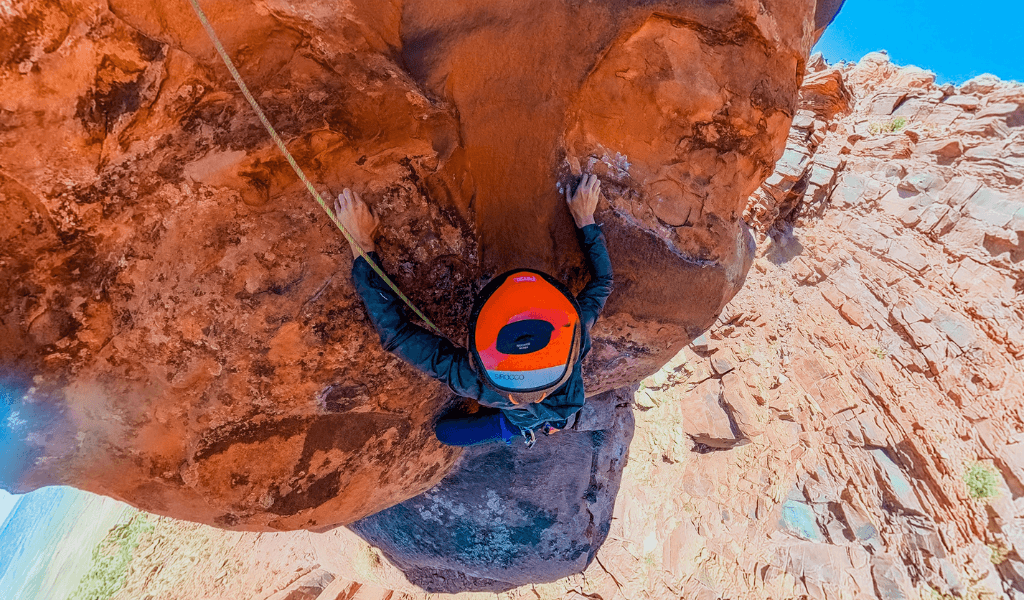
Especially when falling or weighting the rope is not really the option you want. Cedar told me that if I fell, I would be tangling in space and that it would be a crazy rescue mission to get to me, if at all.
Great, I thought.
That was exactly what I wanted to hear.
And yet that warning only revealed the truth of the situation even more clearly: the only real solution was to stay present enough to keep moving.
That was the new dynamic I had never fully understood before.
On the jump, fear was explosive.
On the tower, fear was immersive.
You don’t just survive it. You inhabit it.
You move inside it.
You think inside it.
You climb inside it.
And somewhere in the middle of all of that, I started seeing something I hadn’t seen before.
Fear was not only something happening to me.
It was something I was in a relationship with.
I had to negotiate with it.
Listen to it.
Work with it without obeying it.
Respect it without collapsing into it.
That may be one of the deepest lessons fear has ever taught me.
The goal is not always to eliminate it.
Sometimes the goal is to stay so present that fear loses its power to distort you.
Because up there on the wall, distorted thinking is dangerous. Panic is dangerous. Fantasy is dangerous. Looking too far ahead is dangerous. Looking too far down can be dangerous.
What you need instead is precision.
Breath.
Focus.
Trust.
One move at a time.
One hold at a time.
One decision at a time.
One moment at a time.
And in that way, climbing became one of the clearest mirrors I’ve ever experienced.
It showed me how fear can either fragment you or refine you.
It can scatter your attention everywhere.
Or it can force you into a level of presence that everyday life almost never demands.
That presence is not comfortable.
But it is alive.
And maybe that is part of why people are drawn to these kinds of experiences in the first place.
Not because they want danger for the sake of danger.
But because these moments strip away the noise.
They remove the illusion that you can be half-present in your own life.
On a wall like that, there is no room for half-presence.
You are there or you are not.
And that might be why fear can become such a powerful teacher.
Because it has a way of eliminating everything false.
It forces honesty.
It forces contact.
It forces you to meet the moment exactly as it is.
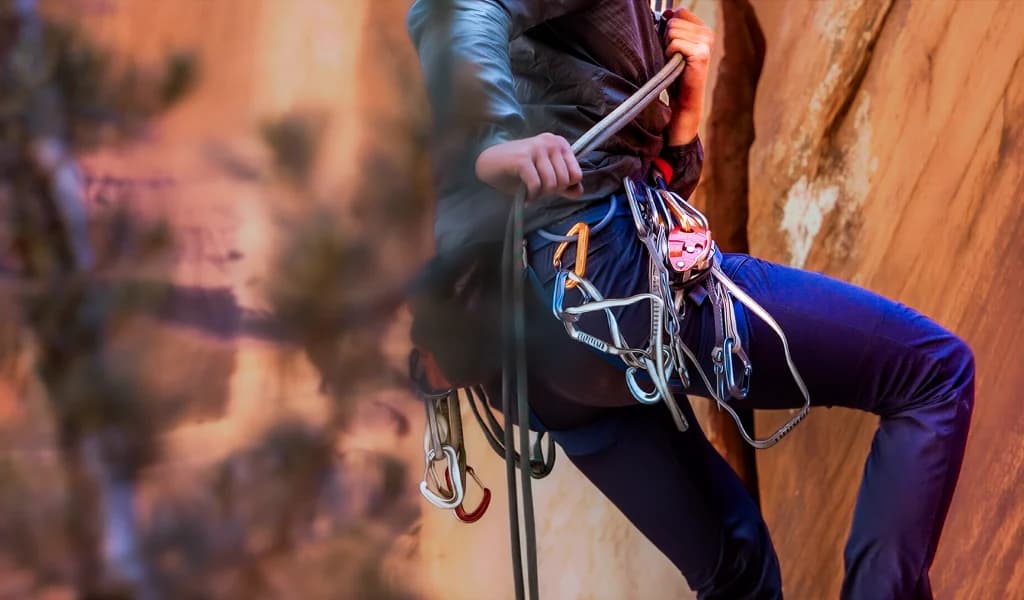
At one point on the wall, I remember getting to a place where the exposure felt almost unreal. Hundreds of feet below. Nothing but air beneath me. The kind of position where your body knows before your mind does that you are very far from anything safe or familiar.
That was the sustained fear.
That was the part no one can fully explain to you until you are in it.
The jump had asked: Will you step?
The tower asked: Will you keep going?
That is a very different question.
And maybe that is what comes after fear.
Not the absence of it.
Not mastery over it.
Not some final state where it no longer touches you.
Maybe what comes after fear is the next form of it.
The next layer.
The next initiation.
The next invitation to become more honest, more present, more alive.
That is what this second chapter began revealing to me.
After Moab, I thought I had reached the other side.
But maybe there is no permanent “other side.”
Maybe there are only thresholds.
One after another.
And every threshold asks something different of you.
The jump asked for surrender.
The tower asked for endurance.
The jump showed me a glimpse of transformation.
The tower asked whether I could live inside that transformation for longer than a few seconds.
And that, to me, is where this all became even more interesting.
Because suddenly the question was no longer just, What is fear?
Now the question had become:
What happens when you step fully into your fear?
What happens when you stop avoiding the thing that terrifies you most?
What happens when you don’t just flirt with the edge, but stay there long enough to learn its language?
That is what I started writing about in this second chapter.
Because climbing that tower made me realize that fear was not just the obstacle.
And it was not just the ignition either.
It was also the guide.
The map.
The thing showing me where I still split from myself.
The thing showing me where I still hesitate.
The thing showing me where more of me is waiting to emerge.
So what comes after fear?
For me, at least in this chapter, what came after fear was not relief.
It was another invitation.
Another edge.
Another negotiation.
Another chance to see whether I could keep following the map.
And maybe that is what this whole journey is really about.
Not reaching some finish line where fear no longer exists.
But becoming the kind of person who knows how to meet it, listen to it, and move anyway.
Because maybe fear is not the thing keeping us from our lives.
Maybe it is the very thing leading us to discover who we really are inside.
And deep within, something was pushing me to keep going towards this fear
Somewhere OUT THERE.
Follow the adventures of JJ Yosh: